

Partner
JSC “Prozorro.Sale” administers a two-tier electronic trading system that connects the central database with accredited electronic marketplaces.
The system hosts auctions for the sale and lease of state-owned, municipal, and private property, assets of insolvent banks, land plots, special permits, and other assets and rights.
It gives businesses and citizens access to auctions, distributes lot information consistently across marketplaces, and allows anyone to follow the bidding process online.
Tasks
Challenges

Keep a 24/7 System Operational
The production environment directly supported live electronic auctions. A service failure could affect application intake, auction execution, and result generation.

Comply With Regulatory Requirements
The ETS logic had to comply with the laws and regulations governing its operation. Technical changes could not conflict with established auction rules.

Protect Data and Result Integrity
The system records participant actions, preserves the auction history, and generates final protocols. Updates could not disrupt the processing of data, documents, or auction results.

Coordinate CDB2 With Electronic Marketplaces
The two-tier architecture connects the central database (CDB2) with electronic marketplaces through APIs. Changes to CDB2 had to preserve reliable data exchange across all system components.

Control Releases Across Three Environments
New versions moved sequentially through test, replica, and production environments. The team had to identify version conflicts, maintain backward compatibility, and prevent technical risks from affecting active auctions.
Solutions
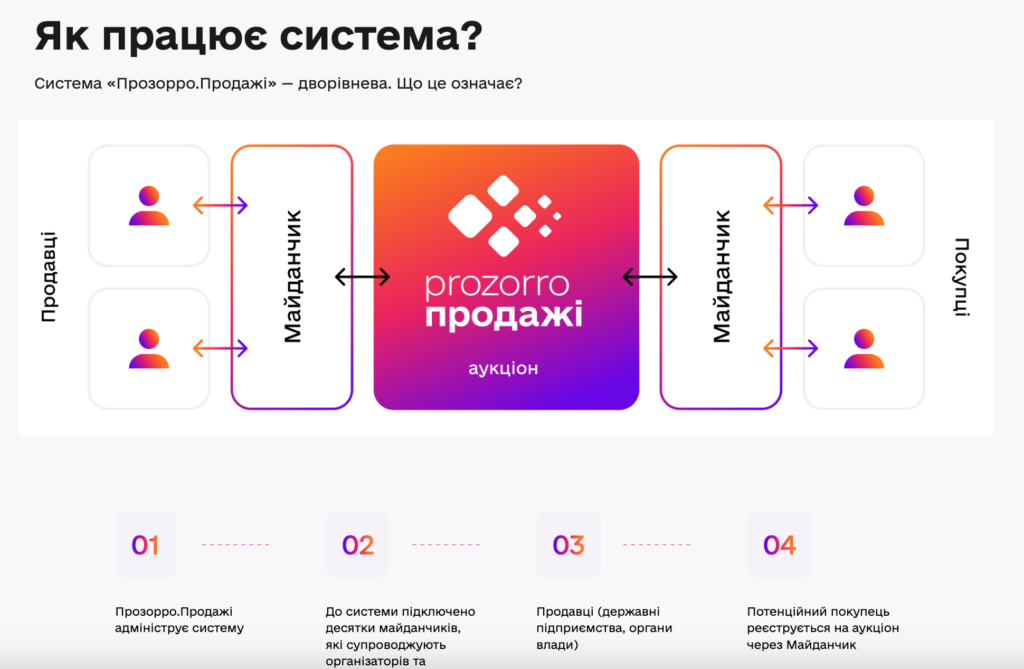
One Set of Rules, Multiple Access Points
Prozorro.Sale operates much like a stock exchange working with brokers. The central database maintains shared auction rules, while electronic marketplaces give users access to bidding.
An organizer publishes a lot through a selected marketplace. CDB2 receives the information and distributes it to every connected marketplace. Bidders can find the lot and join the auction through their preferred service.
No marketplace receives exclusive access to specific lots. Instead, marketplaces compete through usability, customer support, and service quality.
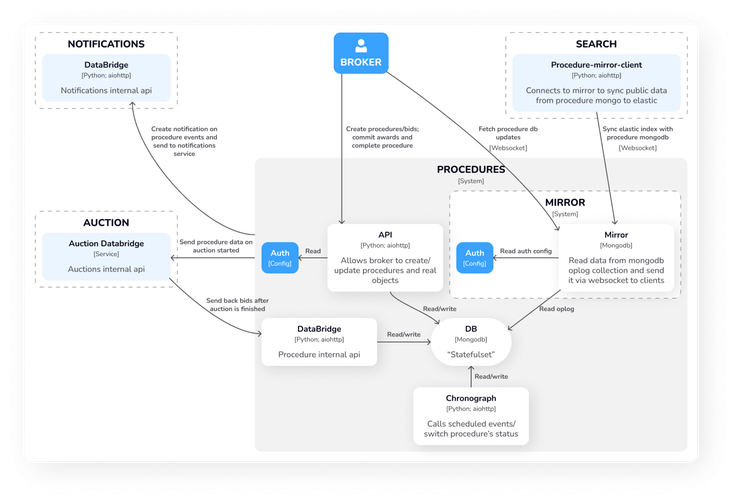
Consistent Logic Across the Auction Lifecycle
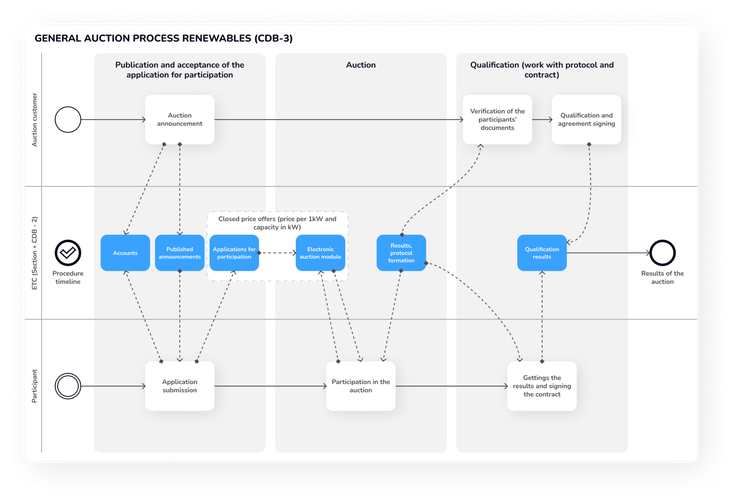
The procedure module manages the auction lifecycle, from publishing an announcement to transferring the results. It stores statuses, timelines, structured data, and electronic documents.
Electronic marketplaces interact with the module through APIs. Connected services handle search, notifications, data storage, and information exchange with the auction module.
This architecture maintains consistent procedure logic regardless of the marketplace selected by an organizer or bidder.
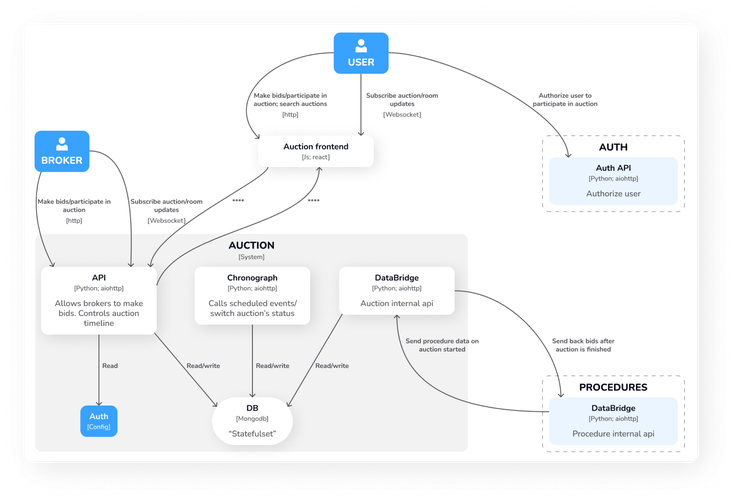
A Dedicated Layer for Running Auctions
When bidding begins, the auction module receives the required data from the procedure module. It authenticates bidders, accepts bids, manages timed events, and records the auction history.
Once bidding closes, the module transfers the results back to the relevant procedure. This separation allows the team to develop auction mechanics independently from lot publication, document processing, and bidder qualification.
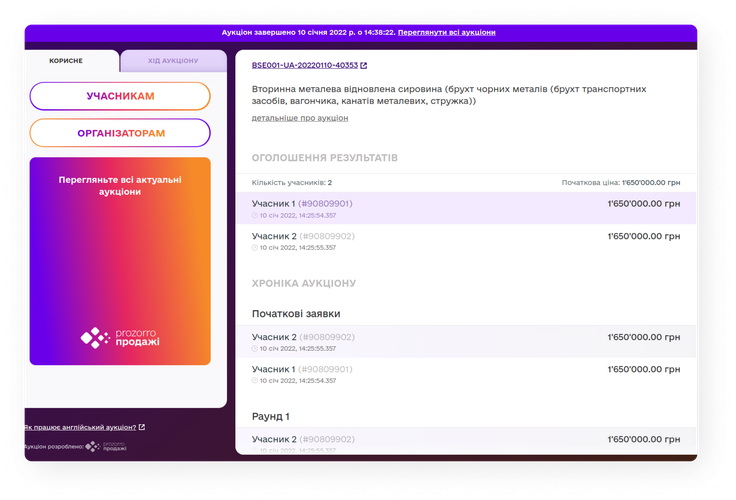
Follow the Bidding in Real Time
The interface displays the current stage, timeline, bids, and auction results. During bidding, the system identifies bidders by number without revealing their names.
After the auction ends, users can review the results according to the rules of the relevant procedure. This approach combines competition during bidding with a verifiable outcome.
Every Change Is Verified Before Release
Each update followed a defined delivery cycle: estimation, development, demonstration, functional validation, and technical acceptance.
The definition of done required at least 75% unit test coverage, integration tests for core processes, backward compatibility, and updated documentation.
After validation, new versions moved sequentially through test, replica, and production environments.
This process reduced the risk of version conflicts or defects reaching live auctions.
Technologies
 Aiohttp
 MongoDB
 Elasticsearch
 Prometheus
 Grafana
 GitLab CI
 HELM
HELM
 Swagger
 GitLab
 Python
 Kubernetes
 Docker
Results

Over UAH 138.6 Billion for Public Budgets
As of September 2026, sales and leases conducted through Prozorro.Sale electronic auctions had generated over UAH 138.6 billion for national and local budgets.

More Than 40 Electronic Marketplaces
Participants can choose any accredited marketplace without losing access to the system’s listings. Every new lot automatically appears across all connected marketplaces.

16 Areas of Operation
The system supports small- and large-scale privatization, leases of state-owned and municipal property, land auctions, and sales of insolvent bank assets, sanctioned assets, special permits, and other assets and rights.

Open Auction Data
Information about lots, bidding activity, and results remains publicly available. Anyone can follow auctions online, creating a foundation for public oversight of state asset sales.

Market Prices Through Competition
Open electronic auctions turn underused property into a resource for businesses, communities, and the state. Competition among bidders helps establish a fair market price.

Independent Oversight
The Supervisory Board of JSC Prozorro.Sale includes state representatives and independent experts. This governance model balances expertise, strengthens strategic management, and supports the Partner’s institutional resilience.
Partner With Us To Guarantee Your Project's Success
Our expert team transforms your vision into a digital solution.
contact us